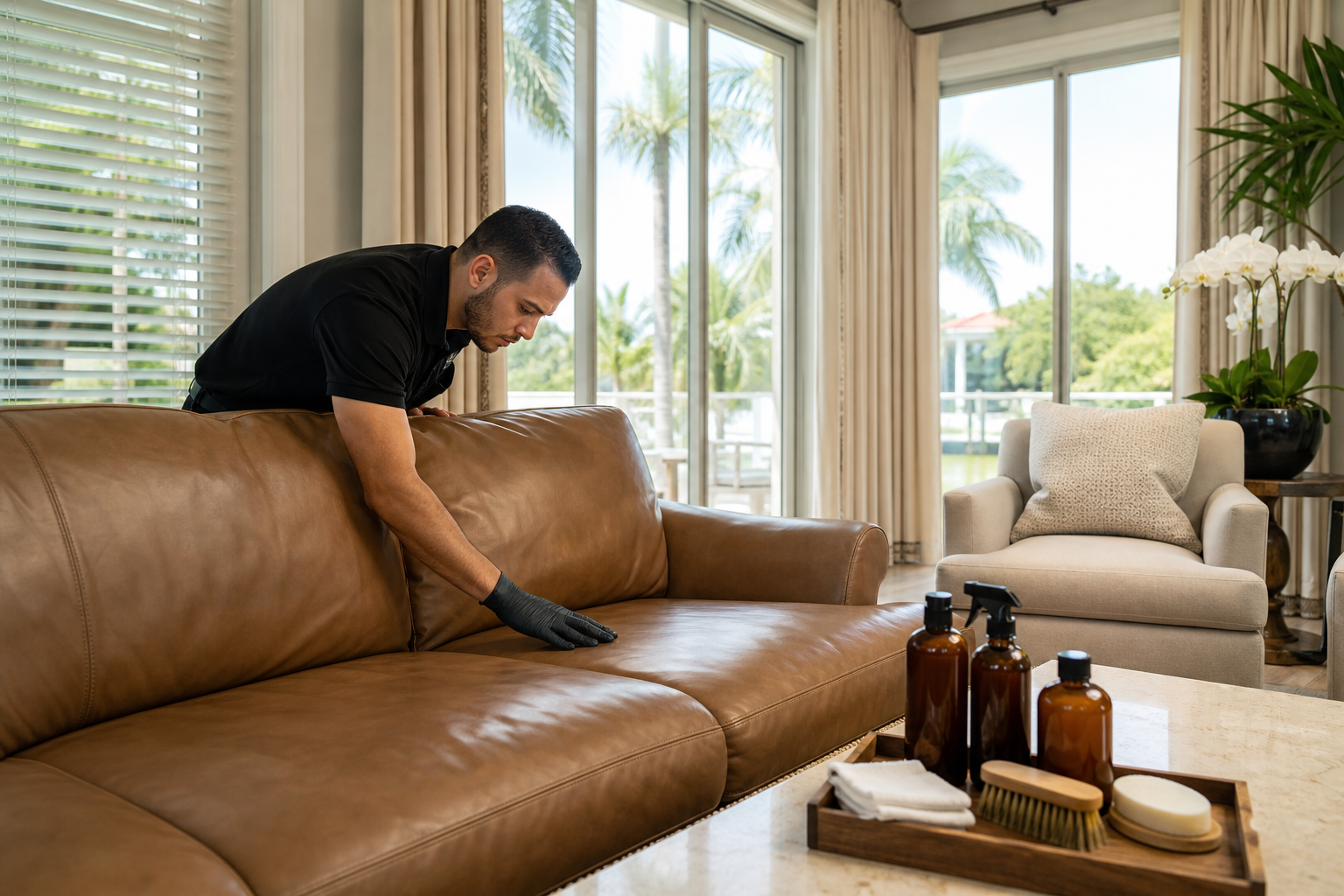
Why household cleaners can damage leather
Leather may look durable, but its surface can be sensitive to the chemicals, moisture, and friction used during cleaning. A product that works well on glass, countertops, fabric, or vinyl may permanently affect a leather sofa, vehicle interior, yacht seat, or office chair.
Household cleaners can damage leather by removing protective finishes, stripping away natural oils, changing the color, leaving residue, or causing uneven drying. In some cases, the damage is not visible immediately. The leather may appear clean at first and later become dry, sticky, cracked, faded, or more vulnerable to staining.
This risk is especially important in Southwest Florida, where heat, strong sunlight, humidity, sunscreen, perspiration, and salt air can already place additional stress on leather. Understanding what not to use—and when to call a professional—can help preserve valuable leather furnishings and interiors.
How leather differs from other household surfaces
Leather is a finished natural material rather than a simple hard surface. Depending on the type and finish, it may contain a protective coating, pigment, dyes, oils, and other treatments that affect how it responds to moisture and chemicals.
Even protected leather is not completely chemical-proof. Its finish can wear over time from body oils, abrasion, UV exposure, and repeated cleaning. Once that finish becomes compromised, an unsuitable household cleaner may penetrate more deeply and cause discoloration or texture changes.
Some leather types, including aniline, semi-aniline, nubuck, suede, and certain exotic leathers, can be particularly sensitive. The safest cleaning method depends on the leather’s finish, color, age, condition, and prior treatments. For background on one common category, see how pigmented or protected leather is cared for.
Common household products that may harm leather
All-purpose cleaners
All-purpose sprays are designed for a range of nonporous household surfaces. They may contain solvents, detergents, fragrances, or alkaline ingredients that are too aggressive for leather. Repeated use can dull the finish, leave a tacky residue, or remove surface protection.
Even when an all-purpose cleaner does not cause obvious discoloration, it may gradually change the feel of the leather. A surface that becomes unusually slick, sticky, dry, or rough should not be cleaned again with the same product.
Disinfectants and antibacterial sprays
Disinfectants can be useful for appropriate hard surfaces, but many are not formulated for leather. Alcohol, bleach, hydrogen peroxide, and other active ingredients may affect dyes, pigments, coatings, and top finishes. They can also dry the material and create light spots or a washed-out appearance.
During periods when cleaning and disinfection are a priority, avoid assuming that a product safe for a countertop or door handle is safe for a leather armrest or vehicle seat. Leather requires a material-appropriate approach that considers both hygiene goals and finish preservation.
Glass cleaner
Glass cleaners commonly include alcohol, ammonia, solvents, or other ingredients intended to evaporate quickly from glass. On leather, these chemicals may dry the surface or interfere with its finish. Spraying glass cleaner near a leather dashboard, chair, or console can also create overspray that is difficult to notice until the surface changes.
Dish soap and laundry detergent
Dish soap and laundry detergent are formulated to break down grease and soils in water. That cleaning strength can be excessive for leather, particularly when the product is used too often or mixed too strongly. Soap residue may remain in the grain, while excess water can create rings, darkening, or uneven drying.
A small amount of mild soap is sometimes suggested as a home remedy, but the result depends on the leather and the exact product. If you are unsure what finish you have, testing an unknown mixture on a visible area can create more risk than the original stain.
Bleach, acetone, and solvent-based products
Bleach, nail polish remover, paint thinner, and similar solvents should not be used as general leather cleaners. They can remove color, soften or dissolve parts of the finish, and create damage that requires redyeing or restoration rather than simple cleaning.
These products can be especially destructive on colored leather, delicate finishes, and areas that receive frequent contact. If a solvent has already been applied, stop rubbing the area and seek an evaluation before trying additional products.
What damage can household cleaners cause?
The effects vary based on the product, concentration, leather type, and amount of friction used. Common signs of chemical or improper-cleaning damage include:
- Fading, bleaching, or a lighter patch
- Dark rings or uneven water marks
- A sticky, waxy, or unusually slick surface
- Dryness, stiffness, flaking, or premature cracking
- Loss of sheen or an uneven finish
- Color transfer onto a cloth
- Raised grain, rough texture, or surface swelling
- Residue that attracts additional dust and soil
Some problems are caused by the cleaner itself, while others result from excessive moisture, aggressive scrubbing, heat, or incomplete rinsing. A professional assessment can help determine whether the issue is surface residue, finish damage, staining, or a deeper restoration concern.
Why Southwest Florida conditions increase the risk
Leather in Southwest Florida often faces a combination of conditions that can accelerate wear. Strong sun can fade color and heat the surface. Humidity may slow drying and contribute to musty odors or microbial growth when moisture becomes trapped. Salt air and sunscreen can leave residues on automotive, marine, and outdoor-adjacent leather. Body oils and perspiration can also build up on steering wheels, armrests, seating, and headrests.
Seasonal homes create another challenge. A property may remain closed for weeks or months while humidity, heat, and limited ventilation affect leather furniture. When owners return, they may try to remove accumulated soil quickly with a strong household cleaner. That approach can spread contamination or create additional finish damage.
For boats and vehicles, wet swimsuits, saltwater, sand, and sunscreen can produce a combination of stains and abrasion. Leather in medical, commercial, and aviation environments may also require careful cleaning practices that support regular maintenance without prematurely wearing the surface.
How to clean leather more safely at home
For routine care, the safest approach is usually gentle, controlled, and limited to products appropriate for the specific leather finish.
- Identify the leather if possible. Check care information from the manufacturer or ask a leather-care professional. Do not assume every leather surface in a home or vehicle is finished the same way.
- Remove loose dust first. Use a soft brush or clean microfiber cloth with light pressure. Grit left on the surface can create abrasion during wiping.
- Choose a leather-specific cleaner. Select a product intended for the relevant type of leather, not a general household spray. Follow the product directions rather than applying a large amount.
- Test discreetly. Apply a small amount in an inconspicuous area and allow it to dry. Check for color change, stickiness, darkening, or texture differences before proceeding.
- Use light agitation. Work in small sections with a soft cloth or suitable brush. Avoid forceful scrubbing, soaking, and repeated passes over one area.
- Allow controlled drying. Keep the leather away from hair dryers, direct heat, and intense sun while it dries. Excessive heat can make leather contract or become brittle.
- Condition only when appropriate. Cleaning and conditioning are separate steps, and conditioning every surface after every cleaning is not always suitable. Learn more about why leather cleaning and conditioning are different steps.
Stop immediately if color transfers to the cloth, the surface becomes tacky, or the leather changes appearance. Continuing to work on the area can spread the problem and make professional correction more difficult.
What not to do when leather is stained
- Do not spray cleaner directly onto the leather unless the product instructions specifically allow it.
- Do not saturate cushions, seams, perforations, or seat piping.
- Do not use abrasive sponges, stiff brushes, or rough paper towels.
- Do not mix cleaning products. Combining chemicals can create unpredictable reactions and increase surface damage.
- Do not apply oils, furniture polish, wax, or silicone products without confirming they are suitable for the leather.
- Do not use a household disinfectant simply because the surface is frequently touched.
- Do not apply heat to force wet leather to dry faster.
For liquid spills, gently blot rather than rub. Coffee, water, and other liquids can spread through seams and absorb into porous areas. For additional guidance, review how to remove coffee stains from leather safely or how water spots and water damage affect leather.
When to call a professional leather-care specialist
Professional help is appropriate when the leather is valuable, delicate, heavily soiled, structurally damaged, or already affected by an unsuitable cleaner. It is also wise to request an evaluation when the leather has an unknown finish or when the area is large and highly visible.
Luxury Leather can assess leather furniture, vehicle interiors, boat seating, aircraft interiors, office furnishings, and other specialty applications throughout Southwest Florida. Depending on the condition, professional service may include cleaning, conditioning, protection, repair, redyeing, or restoration. The correct service should be based on the leather’s material and the type of damage rather than a one-size-fits-all treatment.
Frequently asked questions
Can I use disinfecting wipes on leather?
Many disinfecting wipes contain alcohol or other ingredients that may dry, discolor, or weaken leather finishes. Check the leather and product guidance first, and avoid using disinfecting wipes as a routine substitute for leather-specific care.
Is vinegar safe for cleaning leather?
Vinegar is a popular household cleaning remedy, but it is not automatically safe for every leather type or finish. Its acidity and the moisture used with it may affect color, sheen, or surface feel. Test carefully or consult a professional before applying it.
Can household cleaner damage protected leather?
Yes. Protected or pigmented leather has a coating designed to provide a degree of resistance, but that coating can still be weakened by harsh chemicals, abrasion, and repeated exposure. Protected leather should still be cleaned with suitable products and gentle methods.
What should I do if I already used the wrong cleaner?
Stop applying products and avoid rubbing the area further. Blot away excess moisture with a clean, soft cloth and allow the leather to dry naturally away from direct heat. Photograph the affected area and arrange a professional evaluation if discoloration, stickiness, or texture changes remain.
How often should leather be professionally cleaned?
There is no single schedule for every leather surface. Usage, color, finish, sunlight, humidity, pets, children, passengers, and the environment all matter. A professional can recommend a maintenance approach for a home, vehicle, boat, aircraft, or commercial space.
Protect your leather before damage becomes permanent
Household cleaners can seem convenient, but the wrong product may create a more expensive problem than the original soil or spill. Gentle routine care, appropriate products, and prompt attention to stains can help preserve the appearance and feel of leather in Southwest Florida’s demanding climate.
If your leather has been exposed to a household cleaner or needs careful cleaning, conditioning, protection, repair, or restoration, contact Luxury Leather for a free consultation. Our team serves Fort Myers, Cape Coral, Naples, Bonita Springs, Estero, Marco Island, Sanibel, Captiva, Lehigh Acres, Punta Gorda, Port Charlotte, and surrounding Southwest Florida communities.