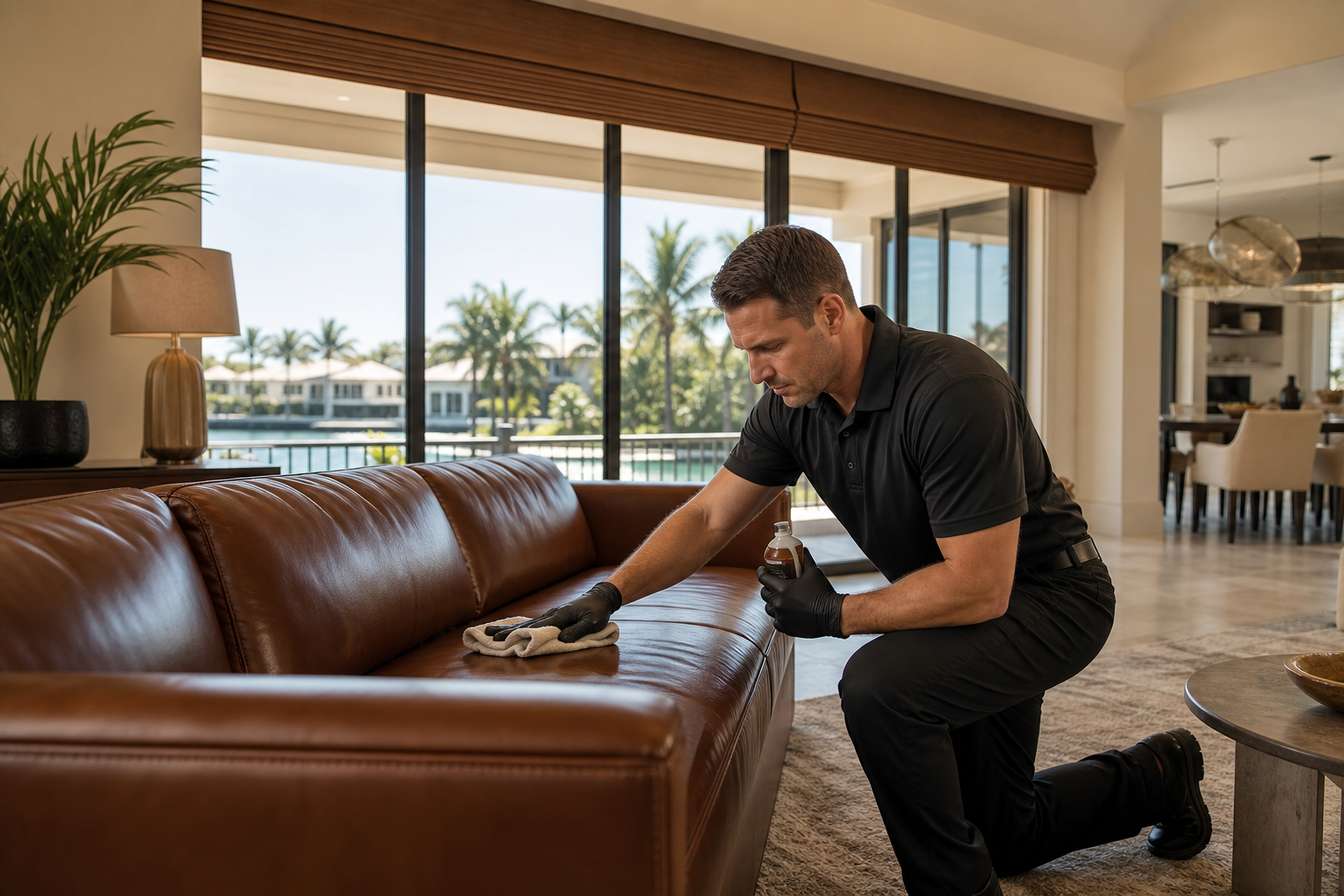
Leather cleaning and leather conditioning are often discussed as though they are the same service. They are not. Cleaning focuses on removing soil, body oils, spills, sunscreen residue, and other contaminants from the leather’s surface. Conditioning is intended to support the leather’s appearance and feel after it has been properly cleaned.
Understanding the difference can help you choose the right care for a leather sofa, vehicle interior, boat seat, office chair, or other valuable leather item. In Southwest Florida, where heat, humidity, intense sunlight, salt air, and seasonal-home conditions can affect leather, using the right process matters.
The most important principle is simple: conditioning should not be used as a substitute for cleaning. Applying conditioner over dirt or oily residue can leave the surface feeling greasy, attract more soil, or interfere with the leather’s existing finish.
What Is Leather Cleaning?
Leather cleaning is the process of carefully removing surface contamination without causing unnecessary wear or discoloration. Depending on the leather type and condition, contamination may include:
- Dust and general household soil
- Body oils from hands, arms, and clothing
- Sunscreen and lotion residue
- Food and beverage spills
- Pet oils, dander, and tracked-in debris
- Salt residue from coastal air or boating environments
- Transfer from dark clothing, denim, or accessories
- Residue from previous cleaning products
Professional leather cleaning begins with identifying the leather and evaluating its finish, color, texture, and condition. A finished or protected leather may tolerate a different approach than an aniline, semi-aniline, suede, nubuck, or specialty leather. The wrong cleaner, excessive moisture, aggressive scrubbing, or an unsuitable household product can create additional damage.
What leather cleaning can improve
Appropriate cleaning may improve the appearance of dull or soiled leather and help remove contamination that makes the surface feel sticky or uneven. It can also provide a cleaner foundation for additional care, such as conditioning or protection.
Cleaning does not automatically repair cracking, deep scratches, peeling finish, color loss, ink damage, or structural problems. Those conditions may require leather repair, redye work, or restoration rather than routine cleaning alone.
What Is Leather Conditioning?
Leather conditioning is a care step designed to support the leather’s appearance, suppleness, and overall presentation. A conditioner may help a properly maintained leather surface feel less dry and look more finished, depending on the product, leather type, and condition of the material.
Conditioning is not a universal solution. Some modern leather finishes are sealed and require little or no traditional oil-based conditioning. Certain unfinished or highly absorbent leathers may react differently from coated upholstery or automotive leather. Applying the wrong product can darken the leather, leave an oily film, alter the texture, or create uneven results.
What conditioning can and cannot do
Conditioning may be appropriate as part of a broader leather maintenance routine, especially after professional cleaning when the leather and finish are suitable for it. However, it cannot restore missing color, rebuild cracked material, remove deep stains, or reverse peeling caused by finish failure.
Conditioner also cannot compensate for prolonged exposure to direct sunlight, heat, humidity, moisture, or neglect. When leather has significant wear or damage, a professional evaluation is more useful than repeatedly applying consumer products.
Leather Cleaning vs. Leather Conditioning at a Glance
| Leather care step | Main purpose | When it may be needed | What it does not do |
|---|---|---|---|
| Leather cleaning | Removes surface soil, oils, residue, and some stains | When leather looks soiled, feels sticky, or has visible buildup | Repair deep damage or restore missing color |
| Leather conditioning | Supports the feel and appearance of suitable leather after cleaning | As part of an appropriate maintenance plan for compatible leather | Replace cleaning, remove every stain, or fix cracking and peeling |
| Leather protection | Helps reduce the impact of future spills or everyday contamination | After cleaning or restoration when suitable for the leather | Make leather stain-proof or eliminate the need for care |
Should You Clean or Condition Leather First?
In most cases, cleaning should come before conditioning. The surface needs to be free from excessive dirt, body oils, and product residue before a conditioning step is considered. Otherwise, conditioner may seal or spread contaminants across the leather instead of supporting a clean, even finish.
A professional may determine that conditioning is unnecessary, unsuitable, or best replaced by another treatment. The correct sequence depends on the leather’s construction and finish, not simply on how dry or dull it appears.
A practical care sequence
- Identify the leather. Determine whether it is finished, unfinished, coated, painted, textured, or a specialty material.
- Inspect the condition. Look for stains, color transfer, cracking, peeling, scratches, fading, loose seams, and previous product buildup.
- Test the cleaning approach. A discreet test area can help reveal whether color or finish may be affected.
- Clean carefully. Remove appropriate surface contamination without oversaturating or aggressively scrubbing.
- Evaluate the result. Once clean, determine whether conditioning, protection, repair, or restoration is appropriate.
- Maintain the leather. Reduce future buildup with suitable routine care and professional service when needed.
Why Southwest Florida Conditions Matter
Leather in Fort Myers, Cape Coral, Naples, Bonita Springs, Estero, Marco Island, Sanibel, Captiva, Lehigh Acres, Punta Gorda, Port Charlotte, and nearby communities can face environmental and lifestyle conditions that affect its appearance.
Heat and direct sunlight
Southwest Florida’s heat and strong sunlight can contribute to fading, drying, surface wear, and accelerated deterioration in exposed leather. Leather furniture positioned near bright windows and automotive interiors parked outdoors may require closer monitoring than items kept in shaded, climate-controlled spaces.
Humidity and seasonal homes
Humidity can make leather feel different from season to season and may contribute to an environment where odors, mildew concerns, and residue become more noticeable. Seasonal properties may also go for extended periods without routine inspection. When a home is reopened, it is useful to check leather for musty odors, surface spotting, stickiness, discoloration, or changes in texture before applying any product.
Saltwater and sunscreen exposure
Boat seating, convertible interiors, outdoor-adjacent furniture, and leather items used near the coast may encounter salt residue, sunscreen, perspiration, and moisture. These contaminants should be addressed with an appropriate cleaning process. Conditioner applied over sunscreen or salt buildup is not a substitute for removing the residue.
Common Mistakes When Caring for Leather
Using household cleaners
All-purpose cleaners, disinfectants, alcohol-based products, abrasive powders, and some wipes may affect leather color or finish. A product that appears safe on another surface may be unsuitable for leather.
Over-conditioning
More conditioner is not necessarily better. Excess product can create a greasy or uneven surface, attract soil, and make the leather feel heavy. The right amount and type depend on the material and its finish.
Scrubbing stains aggressively
Hard scrubbing may spread a stain, remove pigment, create a shiny spot, or damage the protective finish. Heat, hair dryers, and excessive moisture can also worsen some problems.
Assuming every leather item needs the same treatment
A leather sofa, automotive seat, yacht cushion, aircraft seat, and exotic leather accessory may have very different finishes and use conditions. Care should be selected for the specific item rather than based on a general product label.
Trying to condition peeling or cracked leather
Conditioner cannot rebuild missing material or reattach a failing finish. Peeling, severe cracking, deep abrasion, and color loss should be evaluated for possible repair or restoration.
When Professional Leather Cleaning Is the Better Choice
Professional service is worth considering when leather has visible staining, persistent odor, widespread body-oil buildup, uneven color, sticky areas, or a delicate or unfamiliar finish. It is also a practical option for high-value furniture, luxury vehicles, boats, aircraft interiors, commercial seating, and medical office furnishings where an incorrect DIY treatment could be costly.
A professional evaluation can help distinguish routine cleaning from a condition that needs repair, redye, color restoration, or a more extensive restoration process. It can also help determine whether conditioning or protection is appropriate after cleaning.
How to Choose a Leather Care Provider
When comparing leather care companies in Southwest Florida, look for a provider that:
- Offers more than one service, including cleaning, conditioning, protection, repair, and restoration
- Evaluates the leather before recommending products or procedures
- Explains what the proposed service can and cannot accomplish
- Recognizes the differences between residential, automotive, marine, aviation, and commercial leather
- Takes care with valuable, delicate, or specialty furnishings and interiors
- Provides clear communication and a professional service experience
Be cautious of advice that treats every leather surface identically or promises that one conditioner will solve all dryness, stains, cracking, or fading. Leather care is most effective when the treatment matches the material, finish, use, and current condition.
Frequently Asked Questions
Is leather conditioning the same as leather cleaning?
No. Cleaning removes contamination from the leather’s surface. Conditioning is a separate care step that may support the feel and appearance of compatible leather after cleaning.
Can I condition leather without cleaning it first?
It is generally better to clean away surface soil, oils, and residue first. Applying conditioner over buildup can leave the leather greasy or uneven and may trap contaminants against the surface.
How often should leather be cleaned and conditioned?
There is no single schedule for every leather item. Frequency depends on the leather type, use, exposure to sunlight and humidity, contact with body oils or sunscreen, and the manufacturer’s care guidance. A professional can recommend a suitable maintenance approach after inspecting the leather.
Does conditioning fix cracked or peeling leather?
No. Conditioning may be part of routine care for suitable leather, but it does not replace missing material, repair structural damage, restore peeling finish, or bring back lost color. Those issues may require repair or restoration.
Can leather conditioner remove stains?
Conditioner is not a stain remover. Stains should be evaluated and treated with a cleaning method appropriate for the leather and the type of contamination. Some stains may require specialized restoration work.
Protect Your Leather With the Right Care
Leather cleaning and leather conditioning serve different purposes, and using them in the right order can help preserve the appearance and usability of valuable leather. In Southwest Florida, regular attention is especially helpful for leather exposed to heat, sunlight, humidity, salt air, sunscreen, and seasonal changes.
Luxury Leather provides professional leather cleaning, conditioning, protection, repair, and restoration services for residential, automotive, marine, aviation, and commercial applications throughout Southwest Florida. Contact us for a free consultation.